

Is Dating That Boring Man Equivalent To Dancing With The Devil?
An Astrological inquiry into British Vogue’s viral article through the lens of Black Moon Lilith’s ingress into Sagittarius on the same day

The focus of this essay is to use Black Moon Lilith’s ingress into Sagittarius to explore the chart of Chanté Joseph’s viral article in British Vogue, “Is Having a Boyfriend Embarrassing Now?”
I will touch on what led me to write this essay, how I generated the chart of the Vogue article and some astronomical and astrological archetypes associated with Lilith, the Goddess of the hour. I will be exploring the work of brilliant writers and thinkers to give social context to the themes in the chart and springboard into examining what the chart is trying to tell us about the quality of time we find ourselves in. What is at stake when women and femmes blindly enter relational dynamics that have centuries of oppressive scaffolding built into them? In what ways does the public discourse’s stuckness in the same old soupy syrup of semantics and whatabousim, around gendered violence and bodily autonomy, demonstrate a dying paradigm that is desperately trying to save itself from its ultimate demise? Lilith’s ingress into Sagittarius on the day this article on British Vogue was released is a prayer for a world where women’s creative and psychological lives are no longer hijacked by men and the patriarchy, who insist we give up our Aliveness in exchange for a life filled with confusion, erasure and self-abandonment.
But we have a long way to go, and the first step is to no longer hold on to this dying paradigm. With the ruler of this aspect and the entire chart, Jupiter, in the 8th house of secrets, power dynamics, sex and death, this is cautious optimism that signals that some things are indeed beyond repair. They are rotten at the core. This line we are drawing in the sand is an answer to a prayer our foremothers made under the ancient stars.
What led me to write this essay
I had no idea this article existed or went viral until the beginning of this month. I didn’t have any social media accounts until about 3 weeks ago, when I made an IG account to promote my writing. Shortly after, I was scrolling through a random Reddit forum about singlehood, and I saw this essay referenced, and the title, just like most people, caught my eye. It was a delightful read, and I let it marinate in me deep into the evening here in the south west of England. Suddenly, I had the first thread of an astro download, and a voice inside of me said that Lilith is breathing down the neck of this article’s chart. I had no idea when this article was released, let alone the chart of the article(for my non-astro friends, everything has a birth chart, not just humans). I was sceptical and decided to do “light research”. My research was not light after all. I held my breath as I opened the chart of this article, and Lilith was right there, arms crossed, looking me up and down, exhausted. Her message was simple: I told you.
On a normal Friday when there isn’t a new moon in Aries, including 7 planets in the same sign ( never have these exact planets lined up in the sign of Aries before) i am a pretty fast writer. Aries fiery athletic instinct is second to none. Hence, you would think I would whizz through this essay with unusual gusto and speed. Not at all. I felt the energetic force and weight of this article’s chart sit on me like a hot, wet blanket that wants to burn ferociously but is instead imploding beneath its own fabric. It felt like trying to hike up a steep mountain with combat boots, only to realise the entire trail is muddied and each step in and out of the muddy ground feels like eternity. I persisted anyway.
A Summary of the British Vogue article
Writer Chanté Joseph’s viral British Vogue article “Is Having a Boyfriend Embarrassing Now?” speaks to how women are beginning to decentre men for different reasons. This is because the identity of women in heterosexual relationships has become centred around a man, and rarely is the reverse true. The article further argues that women are rewarded for keeping or finding a man, and many women leverage this for engagement and financial gain. Chanté notes that there’s been a shift whereby women want the best of both worlds: The social currency of being linked with a man while also appearing single. The strange straddling of the two worlds can be seen by online posts where the identity of the man is deliberately obscured by inserting just his hand on the steering wheel or the back of their shadowy silhouette. This allows women online to appear non-male-centred while also taking advantage of “the clout that comes with” being partnered with a man. The article highlights that the facade of heterosexual relationships is slowly being unveiled, and the fantasy is dying. Women are less impressed by the mental, emotional and psychological gymnastics of heterosexual dating. According to Chanté, “it is no longer a flex” to be partnered. Heterosexuality is becoming politicised in ways that other sexualities have been in the past. People are waking and denouncing their blind allegiance to heterosexuality.
The timing of Lilith
Black Moon Lilith is not a planet or a celestial body; like the nodes, she is a point in the sky. The Moon has two main points in its wobbly elliptical orbit around the Earth: One is the lunar perigee, which is its closest orbit to the earth and the other is the lunar apogee, the Moon’s furthest orbit from the Earth. The latter, an empty ghostly point, is Black Moon Lilith(BLM). True to her wilderness, BLM stations retrograde every month and takes roughly 9 years to complete her journey around the entire zodiacal wheel. She doesn’t journey through a single sign linearly. At any given time, she is dancing between 3 zodiacal signs. Cue Ciara’s 1-2 step. The chart we are looking at today(see below), BLM ingressed into Sagittarius the third time since her first entry after 9 years, on June 16th 2025, at 07:51 am. She ingressed back into Scorpio at exactly 1 am on June 23rd 2025, and ingressed back into Sagittarius on July 18th 2025, at 18:13. She moved back into Scorpio on July 25th 2025, at 16:03 and then for exactly 4 months ( July 25th-October 25th, 2025) goes back and forth between Scorpio and Libra. On 25th October 2025, for the third time, she comes back into Sagittarius at exactly 05:36 am on 25th October 2025 (BST), the very same day the viral British Vogue article “Is Having a Boyfriend Embarassing Now?” written by Chanté Joseph was released.
How I was able to generate the birth chart of this article
The exact time this article was released is not publicly available, but after some sleuthing, I found that Chanté informed her audience that the article was out on her Instagram at around 12:36 PM UK time on 25th October 2025. The Ascendant was at 25 degrees Sagittarius. The Ascendant point shifted into the sign of Sagittarius at 10:25 AM that morning, and Lilith ingressed into Sagittarius at 5:36 AM earlier that morning. My hunch is that the article came out between 10:25 AM and when Chanté posted news of the article on her IG. So, I decided to go with the chart that has Sag on the ascendant at 24 degrees at 12:31 PM. Why 12:31 and not when it was posted on IG? I thought there would be at least a few minutes between the article being out and her announcing it on IG. With this article being a Sag rising, Jupiter becomes its chart ruler, placing Lilith in the first house of the self, body and personal identity.
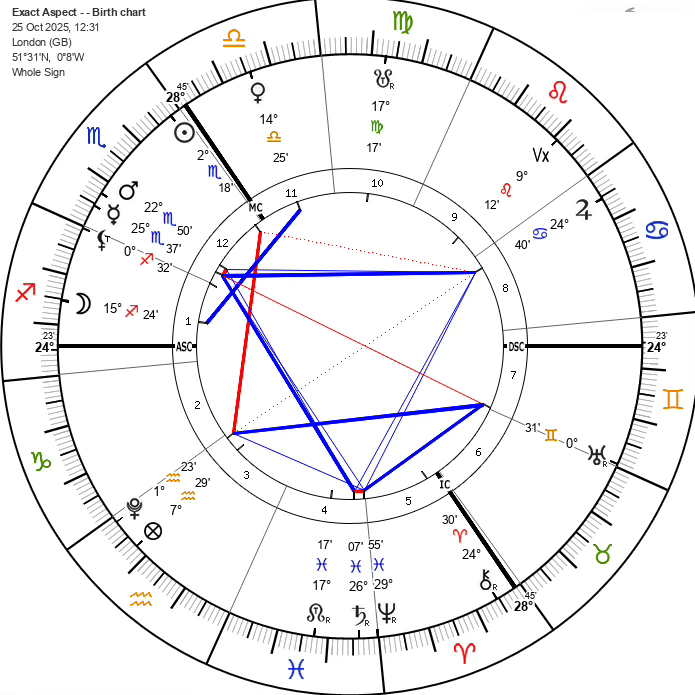
Also, FYI, I use the True Black Moon Lilith point, not the “Mean” position, the asteroid or the million other astronomical Liliths out there. I also use the Whole Sign house system to read charts. So, let’s dive into Black Moon Lilith and the subsequent chart analysis of this article.
Lilith’s myths and how she moves through the world through an Astrological lens
There are many myths and origin stories of Lilith, but this won’t be the focus of this essay. My focus is to use Lilith’s ingress into Sagittarius to explore the chart of Chanté’s article in British Vogue. Some say Lilith was present in the myth of the Sumerian Goddess Inana Ishtar, as the snake, the Anzu bird and the violent storm that seized Inana’s hulupu tree that she was hoping to make her marriage bed and throne from. Some say that Lilith is the first wife of Adam, who was created as his equal, unlike Eve, who was made from his rib. Lilith wanted to be on top during sex, straddling him, and Adam refused because he felt superior to her. She took the matter to “god” and he took Adam’s side. She basically said fuck you, said god’s real name, which was forbidden and was thus exiled to Earth. god even sent angels after her to try and get her to conform, but she refused the golden handcuffs. There are many subsequent myths about what she does on earth from a patriarchal lens, but I will leave that part out for now.
Lilith is older than the Earth itself. According to Astrologer Tom Jacob (may his soul rest in peace), she predates the particular philosophical system of today’s world that is obsessed with logic. The nucleus of this system is one of social order and social control. The story of Lilith exists alongside the story of patriarchy, which became refined over 6000 years with the onset of monotheism and Abrahamic religions. Tom Jacob argues that the intention of patriarchy is the handing down and preservation of power and control, by ensuring property is only handed down through male lines of ancestry. Although this specific tradition may not be as strong in the current postmodern era, the fact that women could not open their own bank accounts until 1974 in America, the so-called land of the free, and in the tail end of 1975 in the United Kingdom, highlights a consistent throughline. I wonder, without the necessary disruption(Lilith) of the second wave of radical feminism in the 70s, if many of us femme-bodied folks would still need a male guardian to open a bank account?
Tom Jacob posits that patriarchy’s attempt to shape, direct and control women’s sexuality is an inherent judgment on feminine energy. Writer and somatic depth practitioner Alexandra Winteraven says that “feminine energy bleeds through thresholds and leaves teeth in whatever resists it. It’s pressure to the lungs, heat under the skin, and rot refusing to be deodorised. It’s silence that swallows language”. Tom Jacob argues that even with the decline of religion and rise of scientific advancement, the obsession with data and feeding of the logical mind is all an attempt to control the parts of reality that are emergent and invisible. This is why Lilith is demonised until today, despite advancements in gender equality, because, as Alexandra infers, the architecture in question often remains untouched while notions of gender equality are positioned outside of the structure that benefits from the extractions of resources that are possible when they are not named. Oppressive systems posit themselves as either a neutral witness to oppression or the benevolent saviour to the rescue. It, and people who benefit from the dynamics of oppression itself, can never be directly named, like the demiurge called “god”, otherwise you become Lilith.
Here are common Lilith projections: too much, crazy, promiscuous, rebel without a cause, hard to reason with, difficult, bitchy, spiteful, rageful, dangerous, demon, villain, femme fatale, succubus. However, these are the ways she often shows up in the personal and collective unconscious: protecting those on the margins and the silenced, the search for radical and total freedom, dedication to preserving one’s individuality and autonomy, deviance ( as in the root word, going ones own way, a path of individuation), independence, natural wilderness of the body and soma, embracing the unknown, listening to the animal instincts and biochemical-hormonal-endocrinological-guttural intuition over group think or what others think you should feel. Because of the cis-hetero-racisialised-patriarchal ableist culture we reside in, we often only feel her when someone’s right to fully exist in their body is under threat. We see her in opposition to order and harmony. We see her as reactionary because she is only ever allowed to exist on the margins, never the centre. Even if we don’t directly villainise her, we are often afraid of her unpredictability because we haven’t carved the space inside of us to have an emergent identity outside of the ones we have been incarcerated into due to primary and secondary socialisation. The degree to which you devalue the right for one to exist fully in their body, as they are, in total resonance with its intelligence and gifts, is the degree to which you will demonise Lilith and those who have answered her calling.
A psycho social exploration of the chart ruler and the ruler of Lilith in Sagittarius—Jupiter in Cancer— sitting in the messy 8th house
In the chart of this viral article, Lilith sits in the first house in Sagittarius at 0 degrees and 32 minutes, with the moon further along at 15 degrees and 24 minutes Sagittarius. They are not conjunct, but the moon is the ruler of Jupiter, who happens to be the chart ruler. Jupiter is in Cancer in the 8th house, which circles us back to the moon and Lilith. I consider—and this is different for every astrologer— the chart ruler as the most important planet in the chart, as well as any planet that it aspects. This is because it’s the internal GPS and heartbeat of a chart, so that, as we often do, get lost in the messy business of being a human; it’s the planet that brings us home to our Self. It’s the planet that midwifed us into this physical incarnation and body. In this chart, Jupiter, the chart ruler, forms a water grand trine to Saturn in Pisces and Mercury in Scorpio and forms an exact square to Chiron in Aries. More on that later.
To begin with, regardless of which house Lilith sits in, she will, according to Tom Jacob, bring the energy of the instinctive-wild, root chakra, primordial, visceral, intuitive, yes-no function of the body. He gives the example of someone speaking about a person they want to introduce you to, and they sound great on paper, but as soon as you meet them, there is a biochemical visceral non-resonance and disharmony you feel, and you feel it’s an immediate no. The gap between that immediate no and the logical mind is where inherited shame and judgment about this feeling take effect. Tom Jacob says that if we could learn to not shame this immediate no inside of us and simultaneously not degrade the person in question, we would live in a radically different world. Many of Lilith’s themes emerge when our right to make life-affirming, independent choices from this yes/no pre-logic place has been continually denied, gaslit or overridden. We internalise this shaming gaze and call it being practical, safe and responsible. As we will explore, this has been the case for femme-bodied people, that our right to choose who we enter a relational field with, such as dating, has been corrupted by an architectural overlay that insists we orient and shape ourselves around cis men and their desires.
Lilith in the first house of the body, personal identity, and the Self carries Divine disruption in the body and is very visible to the outside, even if unbeknownst to the Lilithian person or those who bump up against it. This is because there is an unconscious quality to this disruption, which often creates unease and panic in most environments that the Lilith person finds themselves in. These are often environments that are very saturnine in nature, with an organising principle of order, structure and stability. It is often the case in group settings where there is a lead facilitator who needs people to adhere to an invisible social script and, in a way, behave themselves. I’ve noticed the moral panic that infects the air when the Lilith person enters the “chat” is the same whether the Lilith person is in resistance to this force inside of them or has a conscious relationship with it. The difference will be how the Lilith person narrates the experience within themselves.
With Lilith in the first, Tom Jacob states that it’s like people are on a holy mission to feed the Lilith person their shame and make them ingest it in the body and carry it around for them. They are shamed for their visceral emotional reactions to circumstances that warrant this response. Their bodily intelligence and connection to the mystery are perceived as a threat because it’s a force that can’t be controlled or accessed through the rational mind alone. Lilith in the first house is often made to feel wrong for listening to their bodily signals over groupthink and for trusting what they feel over what they are told they are supposed to feel.
Lilith in Sagittarius often receives shame for their mutable nature and for changing the way they relate to their identity when it no longer aligns with their new beliefs. The zodiac sign of Sagittarius is a mutable fire sign, which represents growth, travel, expansion, spirituality, learning, teaching, divine intuition, wisdom, knowledge, the scholar/preacher archetype, faith, freedom, belief systems, philosophy and religion. Some Sagittarian attributes include truth-telling, passion, charisma, shamelessness, extroverted thinking, seeking, and wanderlust. Lilith in Sagittarius is often shamed for holding an emergent moral framework that rubs up against the status quo. The demand of Lilith in Sag when actualised is to be the one who chooses what moral framework, or lack thereof, she organises her body around. According to Tom Jacob, Sagittarius is also concerned with why things happen on a larger scale and the theories and the epistemological framing of how we understand the world around us.
But it’s a mutable fire sign, and so its pacing is quick. What is true today may not be tomorrow. For Sagittarius, this is a sign of growth. But when Lilith is in Sagittarius, it’s projected as being inconsistent and difficult to work with. With this combination, there is often an external repression that’s felt in the body, around a denial for one to have the space to explore and interrogate their belief system. When Chanté wrote this op-ed, talking about how she feels about the current heterosexual dating war zone, people could not get past the title. I do not doubt that at least three-quarters of people who shared their reaction online only read the title. I think it’s the word “embarrassing” and “boyfriend” next to each other that triggered something in the collective unconscious. For thousands of years, men were the prize, and a lot of brainwashing went into keeping this illusion alive. The economy and every other ideological state apparatus, from western psychotherapy to the medical industrial complex, the entertainment world, and the educational system, is built to reaffirm to femmes that their identity and core beliefs should be built around being desired by a man. This is a deep scaffolding that took more than 6000 years to lace itself into the bones of our foremothers and into us. This is an asylum we can’t see. It’s biochemical and endocrinological. So it is on this physiological level that the deviation from this scaffolding that Chanté is naming that the public reacted to. Like someone deep into an addiction being told they are addicted, the word embarrassing pressed against the wound of lifelong self-abandonment for women and anger for power holders.
Lilith in Sagittarius is uninterested in certainty, safety and structure at the expense of being Alive. How we respond to change and navigate repair and reimagination of bold new futures determines our ability to access this Aliveness. In a system that benefits from women being male-centred, codependent romance addicts, any force that rubs against this configuration becomes a dangerous force of destruction, even if that force carries the gift of Aliveness.
This configuration and dance bleed through into queer relationships, too. But that’s for another essay.
Lilith in Sagittarius reminds us that our core beliefs dictate the identities we perform. The Vogue article passed us a trailblazing memo saying that women are beginning to decentre men. But what does decentering men actually entail at the level of the body beyond the talking points?
Alexandra Winteraven argues that decentering men is not as radical as it appears. It is often spoken of as a phase, as something occurring in a vacuum. It is, in fact, “often repetitive, destabilising and unglamorous”. It is work that “continues long after the slogan stops trending”. Alexandra continues that within heterosexual dynamics, people mistake an imprint for desire. Truly decentering men rattles an old scaffolding that demands supply. So then the cycle repeats of seeking the drug of male validation.
I think seeking male validation doesn’t just begin and end in heterosexual dating dynamics. Women who chronically seek male validation often had fathers who benefited from their female partner orienting and shaping herself to his whims and desires. This is deeper than the classic heavily therapized “absent father wound” people are quick to reach to fill this gap. It’s one part of a much more complex story. One that I believe western psychotherapy is blind to due to weaponised incompetence. This is a term we see used vis-à-vis in heterosexual relationships plagued by patriarchal power dynamics, where the male partner refuses to carry their share of the relationship for all kinds of nonsensical reasons as a way to punish and extract energy and free labour from the female partner. The same goes for a field that was founded and dictated by straight, old white men. Even after their death, the scaffolding remains the same.
Western psychotherapy, as an ideological state apparatus, refuses to—beyond PR tokenism and cynical window dressing—meaningfully witness the trauma that systems of oppression perpetuate in the psyches of marginalised groups. Instead, survivors are encouraged to navel gaze at their wounds and strengthen the inner critic inside of them that tells them to pull up their bootstraps, to regulate and police themselves to the point that their selfhood disappears, and thus the pathologising loop of looking at the symptom and not the structure around the wound begins. We will save the patriarchal father wound and male-centred mothers for another time.
Alexandra reminds us that if you have only felt real and alive through a reflection, then without this mirror, a structural silence ensues, and decentering men begin to feel like a loss and a death.
Jupiter in Cancer, the ruler of this chart, is in the 8th house. The 8th can relate to areas of life where the following are concerned: power dynamics, loans, debts, intimate partnerships, financial contracts, shared resources (energy, money, time and any other valuable resource), grief, mental health, astral and ancestral realms, surrender, that which you can’t control, resources that you were given but often with strings attached like a grant, ego deaths, inheritances, intimacy, fears, forms of connectedness that trigger our deepest wounds, psychic phenomena, depth psychology(such as psychoanalysis), trauma work, death doula’s, end of life care.
Tom Jacob describes the preceding 7th house as the PR version of a relationship. In other words, it’s the familiar heterosexual choreography of projecting desire and organising your identity around being chosen and wanted. The 8th house is not just what is behind closed doors, but what is in the basement that no one has gone to. god knows what creatures live in there. The 8th house is where the power over and power under dynamics in a relationship are exposed. Jupiter expands whatever it touches.
Ancient astrologers call Jupiter ‘the great benefic’, which I agree with, but in the context of the 8th house and the overall themes of this chart, benefic sometimes means pulling out the weeds in the garden and getting rid of root rotting before planting new seeds, or having a scary operation that aims to remove a malignant tumour. The themes of Chanté’s article point to what’s always been there, lurking behind the scenes of the main play. The shock from the public ( Lilith in Sag in an exact opposition to Uranus in Gemini) surrounding this article was because the truth is uglier than the public is ready to metabolise. But that doesn’t mean the message isn’t pointing to urgent and important work that needs to be done.
Just over a year before this article was released, a poll went viral on social media called “The man Vs the bear”. The virality was due to the public’s shock that the majority of the participants, who were all women, felt safer to be alone with a wild, undomesticated bear than a cis man. Similar to this article, the public discourse got stuck in the same reactionary semantic soupy loop, like a software that’s refusing to complete its upgrade cycle. No one was interrogating why it is so difficult to hear that male violence is the norm? Why exactly is this revelation disturbing? Unsurprisingly, most of the people staging this vocal shock were cis men. Alexandra writes that whenever the oppressive architecture around a behaviour or imprint is named, men rush to write think pieces and moan over their podcast mics about how they need to do better and take responsibility. The staged horror and the performance of being one of the “good ones” is a way of avoiding how they are still inside the pattern they are condemning. The bar is very low with cis men. Alexandra says, “You don’t have to be drugging, hitting or raping your partner at night to be crossing lines all the time. You do it after you keep talking when a boundary has been set. You do it when you assume your presence is neutral and your presence is welcome.”
They continue that the performance of shock men display by condemning male violence that is more visible, is so they can “keep themselves clean from the rest of it”. However, locating themselves inside of it is something most men refuse to do. According to Alexandra, that would cost them something; instead, they are further capitalising on women’s pain through performative grief-stricken content in the form of likes and subscribers and social currency for sounding aware.
In Chanté’s article, it is mentioned that women are rejecting the current template of heterosexual relating that’s rooted in misogyny. Again, no one is asking why rejecting this template automatically means one has no desire to relate at all. And even if that is the case, who has more to lose?
Alexandra points out that heterosexual dating is less about desire and more about following a familiar choreography than an intentional choosing. True agency in heterosexualism is contingent on whether or not you can sidestep this dance and still make the same choice. Alexandra asks, “Do you desire men or do you desire being desired by men?” They argue that both produce very different sensations; one is in the body, and the other mirrors the male gaze.
When the ruler of Lilith in Sagittarius—Jupiter- is in the 8th house, we see a burgeoning anger around unequal power dynamics which begins to leak out into the public sphere. The first house is a visible and potent place for Lilith to reside. What was meant to stay hush-hush in the 8th house fugitively makes its way to the centre like a random gust of wind on a hot summer’s day. Ancient astrologers said that the 8th house receives no light from the first house. It is an idle place where no activity is happening. But this chart is different. The 8th is receiving plenty of light and divine disruption from the first house. The only thing idle about the 8th house in this chart is our ability to see the gifts it contains. With Jupiter, the chart ruler in the 8th house, subtle forms of manipulation, extraction of resources (energy, time, money, etc.) and abuse when it comes to shared resources in an intimate partnership become magnified. As mentioned, Jupiter enlarges issues that are already present.
When women speak about the unequal power dynamics in a relationship, specifically the implicit expectation that the emotional, psychological and physical labour of the relationship always falls on their back, they are slapped on the wrist and told to communicate more effectively, use “I” statements and try not to trigger her man-child partner because he is “traumatised”. In other words, women are expected to practice self-erasure in a heterosexual relationship and also become unpaid therapists, shouldering the burden of patriarchy’s enabling of infantile male behaviour. She is to ensure that he doesn’t feel the slightest bit of discomfort when being held accountable, while her mental and physical health deteriorates under the continual psychological terrorism she is subjected to. In other cases, couples counselling is suggested, and I find this route very tricky. I think the whole model of couples therapy is flawed, particularly in heterosexual dynamics. Not to digress, but it’s often the woman’s internal and external boundaries being gaslit and her being told to take her partner’s baggage as her own. Her communication, tone and choice of words are heavily critiqued, and the actual system creating the inequality in the first place that enables the man-child’s behaviour is never directly named. Perhaps they both could benefit from individual therapy and go their merry way. But I think there’s something insidious about creating a space where a potential victim of abuse lets their guard down and their abuser gets access to their internal world with the help of a professional, prompting both the therapist and the man-child to prey on the woman to get her to comply to the heterosexual script and continue self abandoning herself in the face of systemic harm.
Much of the backlash against Chanté’s article was the accusation of inciting a “gender war”. With Jupiter in Cancer in the 8th house of unequal power dynamics, intimacy and trauma, femmes have historically had to endure structural abuse in their intimate relationships because patriarchy has decided that their bodies exist to be used and discarded by men as they please. In this paradigm, women’s agency is a threat to the unregulated and free resources men have access to under normal circumstances.
Zawn Villines, in Liberating Motherhood, talks about the “myth of the gender war”. She argues that defenders of misogyny “love to pretend that the violence that is inflicted on women by men is a thing of the past or that it’s a mutual occurrence. According to this myth, misogyny and all that is left in its wake pertain to a small group of men and women. The goal is to create a false equivalence that conceals the truth: There is no gender war. There is no mutual hatred. There is widespread violence and misogyny against women, and there is a non-violent feminist movement seeking to end this abuse.” Zawn continues that equating feminism to violence or a mutual war is an attempt to silence dissent so that men can continue harming women with impunity, as they have done so for so much of human history. They argue that patriarchy insists that women need to take accountability for their abuse. What this means is that certain behaviours of women warrant abuse.
Furthermore, the Vogue article also received pushback because many (mostly men) were angry that men were being painted with a broad brush. The 8th house in astrology also governs sex in an intimate relationship. Zawn from Liberating Motherhood explains that this anger expressed by men towards feminist modes of meaning making is because it threatens the access to something they feel entitled to: Sex, obedience and a relationship. They know they don’t stand a chance in a dating market where they have to live up to any kind of standard, and women having true autonomy (Lilith) over their bodies. Zawn argues that the only way that the majority of heterosexual cis men have had any luck in dating or finding a long-term partner is not because they are good people or bring any value, but because of the free pass and immunity handed to them by the patriarchy. They are immune to accountability, ethics, and all moral standards.
In this mass heteronormative psychosis, the reality of male violence in intimate relationships is distorted, gaslit and slid under a very dirty carpet. Writer and blogger Chidera Eggeru says on her popular podcast show, “The Slumflower Hour,” that marriage is the lowest form of sex work. Professional sex workers have more autonomy as they selectively choose their clients, often going through an extensive screening process. Many provide services that do not involve sexual intercourse and charge a rate for their service that reflects the true value of their labour. However, it’s difficult to say the same for married cis women in heterosexual relationships. It is estimated that 80-90% of sex workers’ clientele comprises married men. Most of the reactions to this statistic were centred around body shaming women and them not being attractive enough for their cheating husbands. When light is shone on a startling statistic like this, the public discourse, similar to the reactions to Chanté’s article, is co-opted by men and male-centred women, who struggle to graduate from the school of semantics, logical fallacies and word play. As Alexandra writes, when a pattern or an imprint is named, women being conditioned to build an identity around male desire, the urge to widen the frame and call it refinement, is actually self-protection. They argue that the urge to neutralise specificity the moment it lands is a part of the architecture being named.
In heterosexual relationships, there is a hidden expectation for women to be a man’s personal, free sexual maid. Always ready, available and eager to give pleasure. You may ask: surely women have the option to decline sex in a heterosexual relationship? Well, if we are going to play semantics, we have the option to do many things. But often women are subjected to harm for exercising their agency to decline sex with their male partners. Zawn from Liberating Motherhood conducted a poll asking her 35000 readers, “What does your partner do when you decline sex?” The results were as follows: 73% of male partners sulk for days, 12% wave their penises at their partner, 10% try to force themselves onto their female partner, 4% become violent, and the remaining 1% threaten their female partner. The results of this poll show that even if women have the agency to decline, the vast majority will be emotionally manipulated into having sex with their male partner.
I think Chanté’s British Vogue article is a sort of pre-emptive dating risk assessment. If the system is set up to produce the kind of heterosexual relationships we have discussed, why would you willingly participate? This question is not an attempt to counter-shame, rather a part of a cost-benefit analysis that stems from a sober, clear mind, free from the hysteria of matrimonia and the comphet-induced brain fog.
The 8th house also governs the fine print of the contracts that we sign. With the ruler of Lilith in Sagittarius, Jupiter, located in this house, we can assume Lilithian footprints are all over the 8th house floors of this chart. Astrologer Tom Jacob says that wherever Lilith touches in the chart, disruption is necessary. With her ruler in the 8th house, the terms of all intimate partnerships come under scrutiny. When Lilith makes contact with the 8th house, there is often a person in the dynamic that carries Lilith’s influence. One partner may have a clear idea for the relationship, and the other partner isn’t feeling it. Lilith represents themes of exile and leaving the table when the terms of a relationships is not rooted in equity. The 8th house also governs the spirit of our ancestors and the ancestral realms. Many of our foremothers did not have the right to get up and leave when they were being treated as less than in their relationships. They were prisoners in their own marriages. They could not have property in their name or open their own bank accounts. Even though some legal advancements have been made, patriarchy is still leveraging whatever it can against women, such as traumatic child custody battles, regression in abortion laws and no-fault divorces, in an attempt to silence them. In many cultures, women who seek to divorce their abusive husbands are disowned by their families or subjected to honour killings.
The themes of the past merging and informing the present are exemplified by Jupiter being in Cancer. The sign of Cancer is described by Astrologer Isa Nakazawa as being the emotional historians and memory keepers. A cardinal water sign, ruled by the moon, it’s a sign that symbolises the idea of home, femmes, motherhood and safety. With the moon in Sagittarius next to Lilith in Sagittarius, there is residual anger meeting us from the past that is shining light on the present. The message is unapologetic and clear: Things will change. The sign of Sagittarius is hopeful and rooted in its optimistic visions for the future. Sagittarius is symbolised by the centaur, a half horse and half human entity holding a bow and pointing its arrow towards the direction of growth and expansion. Centaurs represent the wild, untamed, freedom-loving part of us, combined with our reason and intellect and the power of this unified intelligence. This isn’t blind optimism. It’s trusting that the tiny bit of space we feel in our bodies in between the horrors of witnessing violence is the future winking back at us. Progress is non-linear. This is not easy work, and we may have to wrestle with ourselves and the world around us to access this space inside of us.
Ending with a sensitive yet determined Water Grand Trine and an achy square from Chiron in Aries to Jupiter in Cancer
I believe Chanté’s article started a movement that was already being nurtured by the ancestors. They are fighting with us. This is because Jupiter is in a grand water trine with Saturn in Pisces in the 4th house and Mercury in Scorpio in the 12th house. A grand trine is an astrological configuration where three signs within the same element form a 120-degree angle to one another. It suggests an easy flow of energy between the planets, and their energy can manifest how it’s intended to without much contention. Because we are dealing with the element of water situated in houses that are considered unconscious in their workings, we may not see the blessings and rewards of this signature in a literal and tangible way. The gift may be a shift in the collective psyche, even if it appears volatile on the outside, that is re-orienting itself towards letting go of an old paradigm.
Saturn in Pisces in the 4th house signifies that the dissent in the collective imagination may be because the old structures of the past (Saturn) are loosening (Pisces). The old embryonic fluid we have been gestating in is slowly killing us. With this supportive trine between water signs located in watery houses, certain glasses need to be worn for our pain to be meaningfully witnessed. We need to be asking radically different life-affirming questions. The IC ( Imum Coeli), which in Latin means “the bottom of the heavens”, in this chart is located in the 5th house in the cardinal, Mars-ruled, fire sign of Aries. Chiron is present in the 5th house, making a close conjunction to the IC and an exact square to Jupiter in Cancer.
Before I continue i want to make a quick note to my Astro friends, that the IC in the whole sign house system can be located anywhere between the second and sixth house. Whereas, most commonly in other house systems, the IC is always located in the fourth house. In whole sign, when the IC is located in another house other than the fourth house, it provides additional meaning and context to the themes of the fourth house.
The fourth house is the womb, your birth family and ancestral lineages. The IC is a point in the chart that highlights what area of life rooted and grounded you into existence in your formative years. I’ve seen charts where the IC was in the third house, and the person was raised by their extended family and local community. With the IC in the 5th house in this chart, it speaks to themes around creativity, play, pleasure, children (inner child), self-expression, dating and individuality. With the IC in the sign of Aries, women’s autonomy to choose whether to partner or choose a creative and psychologically rich life is what is at stake here. Aries is ruled by Mars, and Mars in Astrology creates conflict of interests, division and separation. Sometimes it does feel like two realities are mutually exclusive because of the hidden strings attached to one choice, which would eventually demand you abandon your individuality and creative sense of self. In this case, and as echoed in Chanté’s article, women choosing to opt out of heterosexual dating is not due to a lack of desire for intimacy or love, but perhaps a preservation of the Self where all source of Love originates from. Without access to this part of us, which heterosexual relationships often demand we give up for a man, any cheap romance we may experience in dating will never be enough.
IC in the sign of Aries is speaking to a deep need to centre one’s pleasure, creative life force energy and expression of selfhood without men and the patriarchy interfering or dictating the terms. If women are as free as we are told they are, why did this article— by a writer doing her job writing about her acute observation of women beginning to decentre men—hit such a nerve? Surely women can express disdain towards boring heterosexual dating scripts?
Astrologer Melanie Reinhart on her guest appearance on the podcast “on the souls term, ep 96”, refers to the IC as “I can’t see”. I have come to see this in my own practice, whereby this part of the chart we can’t see due to social conditioning, early imprints from the family and other systemic and cultural patternings. We also can’t see our IC often because of other psycho social illusions that keep us—long into adulthood and old age— recreating from the same old amniotic fluid we were fed.
With the IC in the 5th house in Aries, we truly can’t see women as whole, entire people if men are not in the picture. Anxieties around “the clock running out” and matrimonia are all examples of the heterosexual agenda being shoved into women’s psyches. This is artificial and socially generated fear. One that has cost many women their lives and personal agency. In this act of emotional terrorism from the patriarchy, women struggle to find the internal space to ask: Do I want to shape and orient my identity around male desire? To what extent is the current dating culture supportive of the kind of life I envision for myself outside of the heterosexual protocol?
Society’s refusal to see women as whole people outside of their connection to men has created an unhealable injury that never closes until we properly face how women are socialised to abandon themselves, their bodies, voices and intuition to survive in a hostile male-centred world. I say unhealable injury because Chiron in Aries—the wounded healer—is closely conjunct the IC in the 5th house, also forming an exact square with Jupiter in Cancer 8th house— the ruler of this chart. Repair goes beyond institutional legislation or reparation. It requires an entirely new world order, new belief systems and moral frameworks (Sagittarius) to see shifts. With Saturn in the 4th house of Pisces, this injury is multidimensional and etheric. It is a direct assault and manipulation of earths frequency and heartbeat. Saturn in the house of ancestral lineage and the ground where the bones of our ancestors are buried ( yes—both 8th and 4th house deals with ancestral stuff, but in different ways), we have to walk back, trace the steps and look at the current architectural design with new eyes that can see ways in which the system keeps recreating itself through dysfunction with an illusion (Pisces) of order (Saturn).
What’s grounding this chart is the desire to embark on a path of individuation and collective sovereignty, but this path is intimately linked with Chiron’s unhealable injury of the centuries of being denied this right. With Chiron conjunct the IC in Aries, the heat, the pain and the inflammation that people are quick to dismiss as a “gender war”, needs a much larger container to be witnessed—beyond the rational mind. This is because the body has become the primary site for wounding. The pain is deeply somatised and cannot be neatly organised through cheap, performative and provocative talking points. What is needed is safety and courage, and that safety, at least at the beginning, will not come from groups or systems that benefit from this injury remaining intact. The primary forms of data that would help build a praxis of relating that isn’t designed to re-injure are ideational, anecdotal and symbolic ( Jupiter/Sagittarius/overall grand water trine). It’s important to build third spaces that celebrate the body and its desire to re-orient the old internal choreography and loosen its attachment to this dying paradigm.
Mercury in Scorpio is the third planet in this grand water trine, located in the 12th house. Mercury deals with communication, words, writing, teaching, learning, travel and the mind. The 12th is the house of spiritual retreat, hospitals, asylums, prisons, people who don’t fit into mainstream society, creative incubators(think photography darkroom labs), monasteries and other places of seclusion. Esoteric astrologers refer to the 12th house as the cosmic womb and the place we are all coming from before our physical incarnation. Jungian astrologers may refer to it as the collective unconscious, and the house where dreams and symbols emerge from the psyche.
When Mercury is in Scorpio, which is ruled by Mars and Pluto, it becomes a psychopomp, travelling between the world of the dead and living, collecting valuable insights that cannot be seen in the physical world or articulated with the human tongue. It is more interested in what is not being said rather than the decoration of words. It is interested in interrogating how words are often used as a defence to shield something that is often knarly and sinister. But Mercury in Scorpio’s obsession with the dark is so that it can transform the mind and arrive at a place of radical truth and honesty. There is an amplification of a Martian signature to this grand trine, as Mars, also in Scorpio, is loosely conjunct Mercury in Scorpio. This means Mercury is digging the ground, through all the dirt and camouflage, with some very sharp tools ( Mars rules sharp tools that are used to cut things), to find raw material to hand over to Lilith in Sagittarius, who sits in the succeeding 1st house. Here, Lilith is broadcasting to the world, through the body, the uncomfortable truths that Mercury in Scorpio dug from the collective unconscious.
Lilith, as an archetype, represents primalness, wilderness and authentic self-expression. She is deeply connected to her inner compass and the source of Life. Sagittarius marks grand entrances and long speeches. You will wait until Lilith in Sagittarius finishes speaking. The progression from Scorpio to Sagittarius represents something we thought was dead coming back alive and telling its story. Listening to the stories that survived the 12th house, especially in the sign of Scorpio, is as important as life and death. With Mercury and Mars conjunct in Scorpio in the 12th house, with the sun further behind also in Scorpio ( not conjunct), there’s been a mass distortion and psychic manipulation pre-dating our physical life that is resurrecting itself to grab the mic without asking for permission and will take its rightful position back into the body. Women’s rights movements have historically been dominated by privileged white women, and their focus has been to be picked by the establishment and ask nicely for their basic human rights. They were often waiting to be invited to the old boys’ club whilst disowning their wilderness and anger so that they didn’t appear divisive (Mars).
There is something in the collective unconscious (12th house) breaking out of the psychological asylum of respectability politics and coming, fully alive, with hunger, thirst and adult teeth, back to the body. Going back to the IC in Aries in the 5th house, conjunct Chiron in Aries—with Mars in Scorpio in the 12th house, ruling this aspect, in many ways, we are being asked to investigate why our knee-jerk reaction is to conclude that articles like the one on British Vogue are inciting a gender war. What deeper fear is being expressed by power holders through this false equivalence of power and theatrical victimhood? Why is naming gendered violence and abuse deemed as violence against a group that are the benefactors and often the perpetrators of it? What does this mass projection tell us about the collective core wounding women have to navigate daily just because of the bodies they inhabit? Why is choosing the self-protective option of remaining single seen as extreme (Scorpio), and enduring gendered abuse and the realities of rape culture is not?
Mercury in the foggy 12th house of Scorpio is relentlessly finding the words to express the violence women have to navigate daily, but are forced to remain silent about. But the words are still drenched in and furiously dripping with pomegranate juice. With a grand water trine that includes the ruler of the chart and the ruler of Lilith’s ingress into Sagittarius, Jupiter, we won’t ever find the right words. We may have to accept that a so-called “gender war” is a part of the collective healing continuum and cycles of change. What if we accept that there is a collective rupture in humanity’s psyche, that is beyond repair because the right soil and infrastructure have not been born yet that would meaningfully facilitate repair without re-injury. The priority for now is to stop resisting the ending of the architectural design that’s distracting us with slogans and podcast bros, which is just another effort to refine and shape itself around the continual extraction of women’s life force energy.
With a South Node in Virgo, the only earth placement in the whole chart, there is nothing to fix or change. The South node is a point of release and completion. There is an emptying and purification of the archetype with the sign inhabiting the south node. The public discourse around the impending extinction of heterosexualism shows a male-centred majority that is desperately trying to save, revive and hold onto a dead thing. Cis women quite quitting heterosexual relationships do not need couples therapy or to employ better communication skills. Cis women choosing to stay single do not need more self-love or inner child healing. WE NEED TO LET THEM BE WHO THEY TRULY ARE. That’s the healing, and that’s Lilith’s message.
The remediation offered by this beautiful grand water trine is to let the old go, internally first, and stop giving it energy and fuel. It’s not just about boyfriends being embarrassing as much as it is about the real cost—on all levels—of being in extractive, de facto nonconsensual arrangements within predetermined relational structures designed to slowly kill women.
I chuckled when I saw Saturn ( the planet of order and structure) in this grand water trine in the sign of Pisces of all signs. Even Saturn, the time keeper and task master of the cosmos, has no idea what the solution is. Pisces is a non-linear, mutable water sign that comes last in the zodiacal wheel. Some say Pisces carries the lessons of all the previous signs. This is a sign that represents non-duality, surrendering to the unknown and the Divinity in all things. Formulating language and new structures prematurely misses the point. We are in a sacred grieving process. Lilith’s story predates the conception of planet Earth. Pinning her down and incarcerating her with cheap words and theories is disrespectful to all that she has endured and survived. The elemental dominance in this chart is water. Feel your damn feelings. The body comes first.